
Transforming Data into Decisions at Global Scale
Driving Enterprise Digital Transformation Through Business Intelligence
Summary
A global manufacturing organization specializing in supply chain solutions faced rapid growth, increasing customer complexity, and fragmented data across finance, sales, operations, and supply chain. Leadership lacked real-time visibility into performance, while teams relied heavily on manual reporting and disconnected systems.
The organization launched a digital transformation strategy with one of the key pillars being Business Intelligence that unified enterprise data, standardized reporting, and embedded analytics into daily decision-making. The result was faster execution, improved revenue realization, reduced manual effort, and scalable insights supporting more than $200M in revenue growth initiatives.
Business Challenge
As the business scaled globally, leaders encountered several systemic challenges:
- Fragmented data sources across ERP, CRM, supply chain, and ecommerce platforms
- Manual reporting consuming significant Finance, Sales, and Operations resources
- Limited visibility into inventory, sales orders, pipeline health, and revenue realization
- Inconsistent metrics across regions and functions
- Delayed decision-making, particularly during major customer ramp-ups
The absence of a unified Business Intelligence foundation made it difficult to align execution with strategic objectives.
Vision
The transformation objective was clear: Create a single source of truth that enables real-time, role-based insight across the enterprise. Business Intelligence was positioned not as a reporting tool, but as a strategic capability embedded into standard work for leadership, commercial teams, and operations.
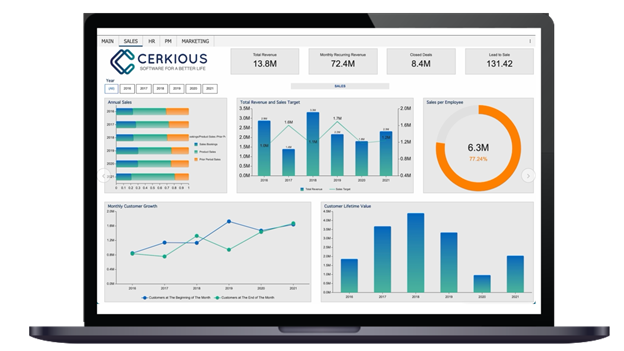
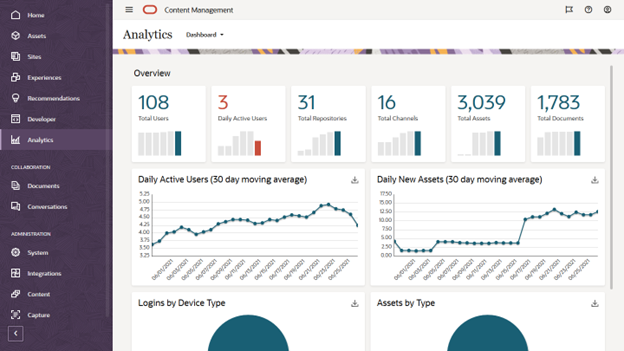
BI Platform Foundation
The organization became an early adopter of Oracle Analytics Cloud, establishing a scalable analytics foundation fully integrated with Oracle R12 ERP, Sales Cloud (CRM), CPQ, and Commerce Cloud. The data from these systems was curated and stored in a data warehouse providing access to leadership. Key elements included:
- End-to-end data enablement across Finance, Sales, Customer Service, and Operations
- Standardized data models for consistent enterprise reporting
- Automated data pipelines eliminating manual spreadsheet reporting
- Drill-down dashboards enabling root-cause analysis at transaction level
Functional Impacts
Finance & Leadership
- Automated financial and operational reporting
- Reduced reliance on manual data aggregation
- Enabled leadership visibility into revenue, margin, and cost-to-serve
- Improved forecasting accuracy and performance reviews
Sales & Commercial Teams
- BI-enabled CRM dashboards for pipeline visibility and opportunity tracking
- Drill-down views into sales stage, deal composition, and probability-weighted revenue
- Identification of high performers (“Team Stats”) to standardize best practices
- Pipeline growth from $16M to $236M driven by improved visibility and adoption
Supply Chain & Operations
- Real-time dashboards for sales orders, inventory on hand, and purchase orders
- Improved demand-supply alignment across multiple distribution centers
- Visibility supporting 98% on-time delivery during high-growth periods
Business Results
The Business Intelligence transformation delivered measurable, enterprise-level value:
Quantified Outcomes
- $40M+ revenue enabled through digital and analytics-driven initiatives
- $1.5M annual cost savings from reduced headcount and manual effort
- 94% increase in sales channel flow through BI-enabled ecommerce insights
- 98% YoY ecommerce revenue growth with lower cost-to-serve
- Faster decision cycles across Finance, Sales, and Operations
Governance & Adoption Strategy
A critical success factor was treating BI as standard work, not an optional tool:
- Established Data Governance model and structure
- Embedded BI dashboards into business review cadence
- Established adoption metrics and usage reviews
- Partnered with business users to continuously refine dashboards
- Ensured tools aligned with upstream and downstream systems
This governance model ensured analytics drove behavior, not just reporting.
Lessons Learned
- Business Intelligence must be business-led, not IT-led
- Adoption depends on relevance to day-to-day decision-making
- Clean, curated data is foundational to analytics success
- BI accelerates transformation when paired with process redesign
Conclusion
This case study demonstrates how Business Intelligence can serve as the backbone of digital transformation; connecting strategy to execution through trusted, real-time insight.
By aligning BI with enterprise processes, leadership rhythms, and growth objectives, the organization transformed data into a competitive advantage, delivering measurable financial impact while building a scalable foundation for future growth.